


The systems that move money, support mobile networks, and sustain global commerce were designed to never fail. And after all this time, they still don’t.
For decades, HPE Nonstop has quietly and securely powered the backbone of the modern world. From ATM networks to airline bookings, and stock exchanges to telecom billing, Nonstop systems have set the gold standard for reliability by delivering a fault tolerance and transaction integrity that few others can match.
As enterprises accumulated terabytes of data every day, Nonstop quietly guaranteed the integrity and continuity of the streams that mattered most. But what began as a race for “more data” to support modernization efforts has evolved and matured since its inception.
Modernization is typically synonymous with migration. Lifting and shifting, refactoring, or retiring are often the only options on the table. But the most advanced enterprises are realizing a better path forward: activation.
Activation connects what already works to what’s next. It makes data continuously available, context-rich, and dependable enough for intelligent systems to rely on. In fact, true AI maturity depends not just on models or compute power, but on connecting authoritative, continuously available data from the systems that have always gotten it right.
That’s where HPE, Striim, and Microsoft meet: at the intersection of reliability, real-time context, and intelligence.
Nonstop’s Value in an Age of Probabilistic Systems
Nonstop systems were built for determinism. Every transaction recorded, every failure anticipated, every recovery automatic. They’re the embodiment of “it just works.”
AI systems, by contrast, are probabilistic. They don’t execute a known outcome; they estimate one. They learn patterns, generate predictions, and refine their reasoning with each new data point. That flexibility is their strength, but also their weakness. Probabilistic systems can infer meaning, but they cannot guarantee it without something concrete to tether them to the real world.
For enterprise-grade AI, these two worlds must converge. Deterministic systems like HPE Nonstop hold the authoritative record of what is—the real, verified heartbeat of enterprise operations. Probabilistic systems, such as AI models and agents, represent what could be—the evolving intelligence that interprets, predicts, and decides.
When combined, they form a closed loop of truth and intelligence: operational systems inform AI reasoning, and AI reasoning, in turn, enhances operational outcomes.
But bridging these two worlds requires more than just data pipelines; it demands a common language of context. In this case, that’s the Model Context Protocol (MCP).
Model Context Protocol: A Common Language for Intelligent Systems
At its core, MCP does something deceptively simple: it defines a standard interface for models to access and interpret live data for AI agents.
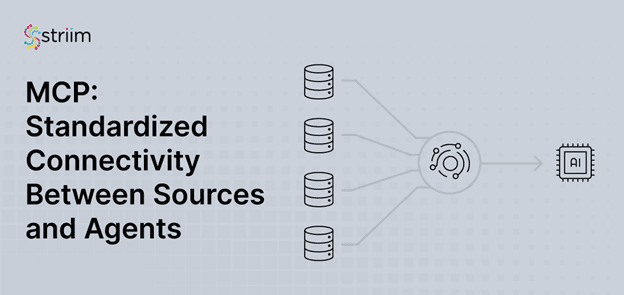
This represents a profound shift in how we think about intelligence. For most of AI’s history, models have been static. They were trained once, fine-tuned occasionally, and prompted with static text to perform specific tasks. What MCP enables is context-driven intelligence: systems reason over what’s happening now, rather than what was true when they were last trained.
That’s the difference between a model that “knows” something and one that understands it in context. However, this real-time reasoning depends on one thing above all: live, trustworthy data that flows without friction.
The Bridge: Striim MCP AgentLink
Striim makes the Model Context Protocol tangible for HPE and Microsoft customers with its MCP AgentLink solution. Striim MCP AgentLink streams committed, immutable changes directly from Nonstop into Azure, where they can be safely consumed by MCP-compatible AI systems.
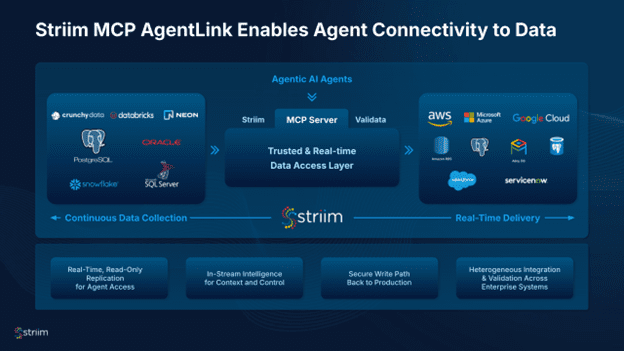
At a high level, MCP AgentLink addresses four integrated pillars:
- Real-time, secure read replicas – Streams changes from 100+ systems (including HPE Nonstop, Oracle, SQL Server, PostgreSQL, Kafka, Salesforce) into MCP-ready zones in sub-second latency so agents query replicas instead of live production.
- In-stream intelligence for context & compliance – Enriches data with joins, metadata, vectors, and PII masking in-flight to meet governance requirements.
- Secure write-back for agentic workflows – Validated write paths to stage, inspect, and approve changes before committing to production.
- Heterogeneous integration & validation – Unifies on-prem, cloud, and SaaS data with consistent quality, security, and compliance checks.
Through these pillars, Striim transforms operational data into live, AI-ready context that Microsoft’s Copilot, Azure AI Foundry, and other intelligent services can reason over instantly. In effect, Striim provides the connective fabric that allows MCP to work as intended, by linking reliable systems of record with intelligent systems of action.
From Transactions to Intelligence: Real-World Applications
In the above architecture:
- HPE Nonstop remains the trusted system of record.
- Microsoft Azure becomes the intelligent system of insight.
- Striim provides the event fabric that lets context flow securely and continuously between them.
Together, HPE, Striim and Microsoft are enabling intelligence without compromise with:
- Reliability to support the world’s most critical systems.
- Sufficient context for the world’s most advanced AI.
- Real-time, trusted data that powers the next era of decision-making.
This is foundationally re-shaping how enterprises think about agentic architectures. What if intelligence wasn’t a layer on top of the enterprise, but a property of it?
In practice, this shift in mindset triggers the transition from operational truth to actionable intelligence. For example:
- In financial services, banks and payment providers rely on Nonstop to process millions of transactions every hour. With Striim MCP AgentLink, those committed transactions can now stream directly into Azure, where AI models in Copilot continuously monitor for fraud patterns, reconcile exceptions, or simulate portfolio exposure in real time. Risk teams can see deviations as they form and act before they escalate.
- In telecommunications, Nonstop systems manage billing, provisioning, and call routing with near-perfect uptime. By streaming those event logs through Striim into Azure, network teams can train and deploy anomaly detection models that flag potential service degradations as they happen. Rather than historical analysis, capacity planning now includes automatically balancing workloads that maintain quality of service at scale.
- In the public sector, government agencies running critical infrastructure often face a tradeoff between security and modernization. With Striim bridging Nonstop and Azure, that tradeoff disappears. Real-time operational data (whether from border systems, utilities, or emergency networks) can inform AI agents that optimize logistics, resource allocation, or incident response, all while keeping data within regulatory and geographic boundaries.
Across industries, the results may be conceptually different, but they are operationally the same: systems built for reliability are now driving intelligence that’s both adaptive and accountable.
The Age of Continuous Context
Enterprises are entering a new phase of intelligence—one where precision, speed, and trust no longer compete, but coexist. The companies leading this next wave aren’t experimenting with isolated models; they’re reimagining the fabric that connects insight to action. They’re aligning systems that have earned trust over decades with platforms that are redefining intelligence today.
For leaders, the next step requires aligning the right foundations. With HPE Nonstop, Microsoft Azure, and Striim, enterprises can achieve a state of continuous context, where every insight, prediction, and decision is grounded in real operational truth.
Together, they offer something rare: the ability to build agentic AI at scale without compromising on truth, security, or continuity. With Striim MCP AgentLink, enterprises can connect agents with context from any and all of their sources and databases. They can send trusted, well-governed, decision-ready data to intelligent systems. And they can do it all in sub-second latency, so agents can make instant impact.
Book a demo today to see how Striim’s MCP AgentLink can bring real-time, governed context to your AI systems.
Be the first to comment